
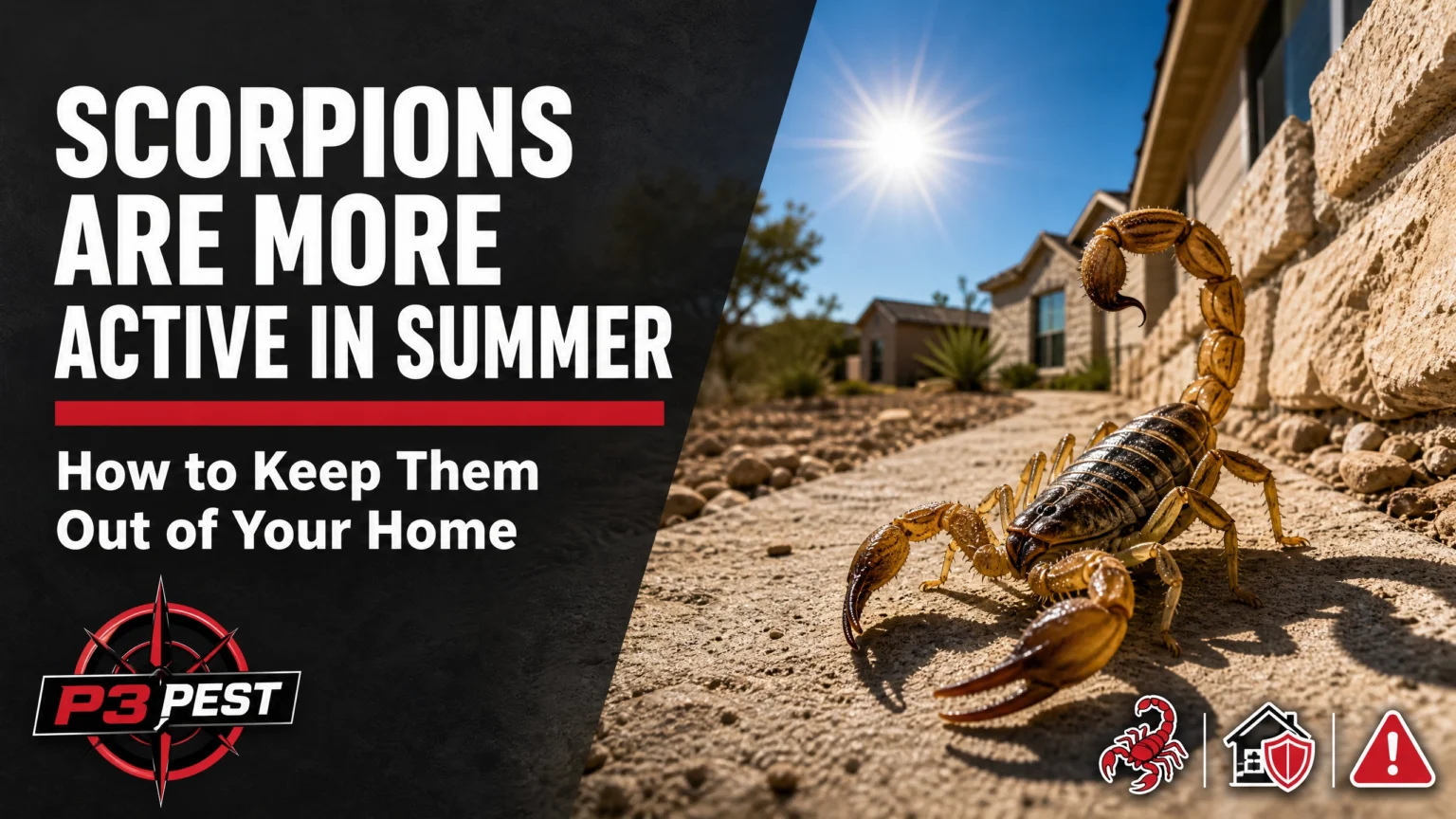
Summer is scorpion season in North Texas. If you live in Weatherford, Fort Worth, or Parker County, you may already know this from experience. A scorpion in the shower, one inside a shoe, maybe a sting from reaching into a dark cabinet. These are warm-weather problems, and they have a specific biological cause.
This guide covers why scorpion activity peaks in summer, how they find their way inside, and what stops them at the threshold.
The One Scorpion Species Every North Texas Homeowner Faces
Texas has 18 scorpion species, but only one lives throughout the entire state: the striped bark scorpion, Centruroides vittatus. The Texas A&M AgriLife Extension confirms it is the only scorpion found statewide. In Parker County, Weatherford, and across greater Fort Worth, this is the species behind virtually every indoor sighting.
Adults reach about 2½ inches long and are yellowish-tan with two broad dark stripes running the length of the abdomen. A dark triangular mark sits just above the eyes. Unlike burrowing species found in drier parts of the Southwest, striped bark scorpions are active foragers that do not dig. They climb trees, scale walls, and are regularly found in attics. That last point matters when understanding summer behavior.
Why Scorpions Get More Active in Summer
Three biological pressures converge in summer to push scorpion activity up. Rising temperatures change where they shelter, mating season sends adults across yards and foundations, and prey populations peak.
Heat Drives Them Out of the Attic and into the House
Scorpions are ectothermic, meaning their body temperature tracks the surrounding air and soil. Warmer nights raise their metabolic rate and increase their need for food and water. On summer nights in North Texas, overnight lows regularly stay above 75°F from June through August. Those warm nights extend the window for active hunting and increase the distances scorpions travel.
During the day, striped bark scorpions shelter in cool, dark locations. Attics in Texas homes routinely exceed 130°F during midsummer afternoons. Texas A&M Extension notes that during periods of extreme heat, scorpions move from attics into the living areas below. This downward migration through wall cavities and ceiling gaps explains most indoor sightings during peak heat. The scorpion is not hunting you; it is escaping an attic that has become uninhabitable.
Mating Season Sends More Adults Across Your Property
The striped bark scorpion mates in spring and early summer. Males leave their daytime shelters to find mates, sending more scorpions across yards and foundations after dark. Female scorpions carry their young on their backs for roughly two weeks after birth. Once juveniles leave their mother, they join the local population on their own. Texas A&M AgriLife Extension reports that litters average 31 young, with a range of 13 to 47.
That means one adult female under a wood pile near your foundation is not a single scorpion problem. She is a breeding source that keeps adding to the local population.
Summer Prey Peaks and Scorpions Follow
Striped bark scorpions feed on insects, spiders, centipedes, and other small arthropods. Those prey populations all peak in summer in North Texas. A yard with active cricket or roach populations is a reliable food source, and scorpions stay close to reliable food. Exterior lights compound this problem. Porch lights attract flying insects, and scorpions hunt near those active light sources. A light that runs all night draws the insects that draw the scorpions.
Where Scorpions Enter Your Home
Striped bark scorpions can fit through gaps roughly the width of a credit card. Your home’s exterior offers several entry points that most homeowners never notice.
Weep holes in brick veneer siding are the most overlooked pathway. These small rectangular openings sit just above the foundation in mortar joints and are designed to release trapped moisture from inside the wall cavity. They are exactly the right width for a scorpion to walk through, and they sit at ground level where scorpion traffic is heaviest. Texas A&M recommends plugging them with copper mesh or small squares of nylon scouring pad.
Door gaps are the second most common indoor entry point. Weather stripping that no longer makes full contact with the door frame leaves a gap that scorpions cross routinely. Slide a piece of paper under your exterior doors at night. If it passes with no resistance, the gap is large enough for entry.
Pipe and conduit penetrations where utilities enter the foundation or walls often leave irregular gaps that go unsealed for years. These openings commonly appear in garages, utility rooms, and behind appliances.
Tree branches and shrubs touching exterior walls or the roofline give climbing scorpions direct access above ground level. The striped bark scorpion climbs readily, and any organic bridge between your landscaping and your home’s exterior becomes a potential entry route.
How to Keep Scorpions Out of Your Home
Prevention works at two levels: eliminate what invites scorpions near your home, then seal the routes they use to enter.
Clear Harborage Away from the Foundation
Scorpions rest during daylight hours in cool, sheltered spots. Wood piles, rocks, leaf debris, and stored equipment against exterior walls give scorpions shelter within reach of your entry gaps. Clear a buffer of at least three feet along the foundation perimeter. Keep grass closely mowed within a few feet of the house. Prune any branch or shrub making contact with the exterior walls or roofline.
Texas A&M also recommends storing garbage cans in racks that hold them above ground level. Containers sitting directly on soil trap moisture and create harborage underneath.
Never bring firewood inside unless it goes directly onto the fire. Scorpions rest in wood piles and ride indoors with the wood.
Seal Entry Points Before Summer Peaks
Walk your foundation with silicone or latex exterior caulk and fill gaps around all pipe and conduit penetrations. Replace weather stripping that shows daylight under the door. Add door sweeps to any exterior door that lacks one. Check that window screens fit tightly in their frames with no bent corners or gaps at the edges.
For brick homes, fill weep holes with copper mesh or nylon scouring pad squares. Expanding foam blocks the drainage function those holes serve, so avoid it.
The most effective time to do this work is late spring, before scorpion season reaches full intensity.
Reduce the Insects That Feed Them
Controlling the insects scorpions eat cuts one of the primary reasons they stay near a home. Switch exterior lights from white incandescent bulbs to yellow LED or sodium vapor bulbs, which attract significantly fewer flying insects. As part of year-round home pest control, Pinnacle Pest Protection applies a perimeter barrier treatment on every service visit. It targets the crickets, roaches, and ants that scorpions hunt, along with granular bait in the yard to knock down prey populations between visits. A lower food supply near the foundation gives scorpions less reason to stay.
Check Your Property with a UV Flashlight
Scorpion cuticles fluoresce under ultraviolet light. The exact mechanism isn’t fully understood, but the effect is consistent and well documented. A UV flashlight reveals scorpions on your property that would otherwise be invisible in the dark. Walk the perimeter of your foundation at night, scan the areas near weep holes, and check any wood or rock piles. Repeated sightings in the same location tell you exactly where exclusion work should start.
When to Schedule a Professional Scorpion Treatment
DIY exclusion and habitat reduction make a real difference, but they rarely resolve an established scorpion presence on their own. The striped bark scorpion climbs and shelters in locations a homeowner inspection misses without training. Seeing one scorpion indoors often means a larger population exists in harborage you haven’t located. Texas A&M notes that finding one scorpion usually signals others are nearby.
Pinnacle Pest Protection’s scorpion extermination service starts with a full property inspection. That inspection identifies active harborage sites, structural entry points, and the insect populations feeding the scorpions. Treatment covers the foundation perimeter, weep holes, window and door frames, and eaves with EPA-approved insecticides. Follow-up granular bait in the yard targets the prey insects that drew scorpions near the home in the first place.
Every treatment includes a free return visit if scorpions appear between scheduled services. If you’ve found a scorpion indoors or seen several near the foundation, the clearest next step is a professional evaluation of the property.
Schedule your evaluation with Pinnacle Pest Protection, or call (817) 518-4192. We inspect before every service and treat the conditions that drive scorpions indoors, not just the scorpions themselves.